
Wolf Handling Ethics & Education: Our Partnership with Dr. Mark Johnson
- Jun 10
- 5 min read
By Geoff Willard, Executive Director
Published in Wolf Tracks vol. 40, no. IV
Winter 2023-2024
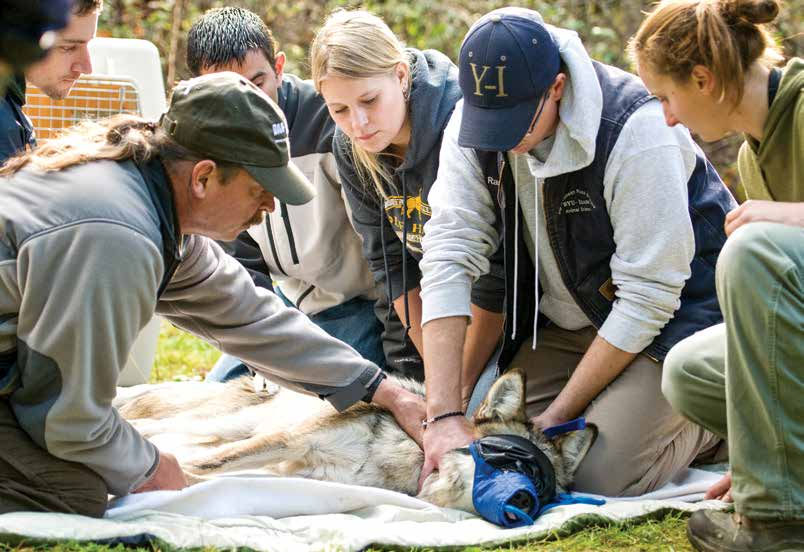
While many veterinarians and biologists are clinicians who work in controlled indoor settings, some must work outdoors in all manner of conditions. If, for example, a wildlife manager needs to capture an animal to collect blood samples or apply a tracking collar, they will typically do this on the animal’s home terrain, using carefully calibrated immobilizing drugs and a dart gun, syringe pole, blow dart, or hand injection. This challenging work requires an expert like Dr. Mark Johnson, who has spent more than 35 years as a wildlife veterinarian working with free-ranging wildlife, and who has partnered closely with Wolf Haven International for almost that entire time as a veterinary advisor.

In addition to the scientific skill required to do this work, Dr. Johnson has honed a mindset that emphasizes respect for wildlife while keeping practices ethical, safe, and humane for all involved. Dr. Johnson says his primary goal is to support and empower individuals in their educational and professional journeys, hopefully helping to improve how animals are handled, one animal at a time. With this goal at the forefront, his work has led him across the wilds of North America – handling gray wolves and bison in the Yellowstone backcountry; moose and wolves on Isle Royale; American Red wolves in North Carolina; and bears around Glacier National Park and Yosemite National Park. He has described his work with grizzlies as inducing a “mixture of emotions, a combination of kayaking and going to church.” This, he says, is because grizzlies present such a great challenge to personal safety and, by their sheer presence and heartbeat, also invoke a profound sense of awe.
In 1991, Dr. Johnson’s unique combination of veterinary and field experience led him to become the National Park Service’s first-ever wildlife veterinarian. Soon after, he was asked to serve as the Project Veterinarian for Yellowstone National Park’s gray wolf reintroduction program. This position also initiated his long partnership with Wolf Haven. As the United States prepared to translocate wild wolves from Canada into Yellowstone (for their eventual reintroduction in 1995 and 1996), the park determined that acclimation pens would be required to safely contain translocated wolves for four to five weeks inside the park, allowing the animals to adjust to the area before being fully released. However, the park service had never done this before and lacked the knowledge on how to design enclosures, feed and care for captive wolves, minimize the animals’ stress or potential harm, etc. Dr. Johnson reached out to Wolf Haven for guidance and then visited Wolf Haven’s sanctuary to learn about its effective and versatile wolf enclosures – with their ground aprons, tip-ins, lack of tight corners, and use of sub-enclosures to support safe wolf handling. The knowledge that Dr. Johnson gained from partnering with Wolf Haven directly informed the design and use of Yellowstone’s wolf acclimation pens, which remain standing to this day and can be visited in Lamar Valley inside the park.


Dr. Mark Johnson teaches wolf handling at the Minnesota Zoo (left) and accompanies a wolf shipping container at Crystal Bench in Yellowstone National Park (credit Jim Peaco/NPS)
In 2004, Dr. Johnson taught his first Wildlife Handling and Chemical Immobilization course for Wolf Haven staff and volunteers. Students learned about the science and ethics of humane wildlife handling using immobilizing drugs. The course was a huge success, and demand for the course surged, leading to Wolf Haven and Dr. Johnson co-hosting a full course at Wolf Haven every year since (except in 2020 and 2021 due to COVID). Typical students in the course are wildlife or captive animal professionals who seek more hands-on handling experience and want to learn from the best. These courses are a perfect partnership for Wolf Haven – students are able to practice wolf handling guided by Dr. Johnson and our animal care team; the wolves receive important health checks, blood draws, and vaccines; and spending the week together helps establish a “community of practice” through knowledge-sharing and networking.

In general, Dr. Johnson prefers that humans not handle wildlife, but because there are occasions when we simply must handle wildlife (either for their safety or for ours), he wants to help spread the absolute best practices according to the highest ethical standards. Dr. Johnson often emphasizes to his students that the application of high ethical values does not compromise their ability to be effective in the field, maintain control of an animal, or do good science. On the contrary, ethical values correctly applied will support those outcomes. The application of calm, competent care can help keep an animal’s heart rate down and make sure an operation runs smoothly and effectively. And working with compassion and kindness can empower us to feel joy for the work, which benefits the animal and everyone involved.
In order to minimize animal and human stressors during a handling experience, one must really work to see the animal, and internalize how the animal may see or experience us. Stress isn’t just an ethical concept. It’s also a biological factor that affects the animal and how well the immobilizing drugs work. This can be a difficult practice to teach, and is often hard to communicate with professional colleagues, but Dr. Johnson has been doing this for several decades now and his style is quite effective. His approach is partly informed by his experience in Aikido – a form of martial art that emphasizes harmony and teaches its practitioners how to stay calm during a stressful conflict.
When asked his favorite thing about working with Wolf Haven, Dr. Johnson insists it is the people. “The staff at Wolf Haven care not only for the animals and environment, but also care for other people. They all seek to support those they meet and engage with at the sanctuary. The Wolf Haven community wants to make the world a better place, one animal at a time and one person at a time.”


Dr. Mark Johnson continues to teach Wolf Haven's annual Wildlife Handling & Chemical Immobilization course to this day, with updated best practices every year
Wolf Haven’s longtime animal care provider and Director of Montana Operations, Wendy Spencer, perfectly summarized what makes our partnership with Dr. Johnson so great. “We have together taught hundreds of wildlife professionals through the years, which has in turn helped raise the general quality of wildlife care year after year. Mark has helped instill in all of us a deep commitment to honor each animal and treat them with respect. I would not be the caretaker I am today if not for Mark – he has been a friend and mentor and I am grateful for what he has done for all wolves.”
To learn more about Dr. Johnson and his courses, visit wildlifecaptureandcare.com, or reach out to Wolf Haven. Our next annual Wildlife Handling and Chemical Immobilization course for wildlife professionals will be hosted at Wolf Haven on September 15-17 2026.


